
Reframing a change programme
The University of Manchester
Services: Student partnership design, change communications, strategy drafting
Overview
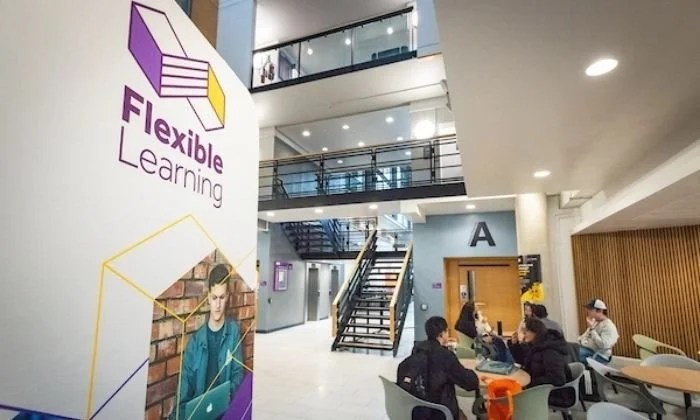
Three months after the Flexible Learning Programme was established at The University of Manchester, I joined to lead its communications and engagement approach. The programme aimed to embed new digital tools and hybrid teaching models to support lifelong, flexible and inclusive learning, but during Covid “flexible learning” had become a contested term, widely associated with reduced in‑person teaching.
I redesigned the engagement approach to place students at the heart of strategy development, transforming a sensitive initiative into a genuinely co‑created programme later recognised by the Students’ Union for its contribution to accessibility and inclusion.
Case study
The University’s approach to blended and digital learning had been fragmented, while market demand for lifelong and stackable learning pathways was growing. A coordinated strategy was needed to align technology, pedagogy and student experience.
The Flexible Learning programme was established in 2020 to set out a vision for inclusive, accessible and international lifelong learning at Manchester. At the same time, the pandemic had heightened sensitivities around digital delivery and trust was low, so the programme needed visibility and credible student partnership.
Challenge
The original brief was to design the end‑to‑end communications and engagement approach for the Flexible Learning Strategy, but it quickly became clear that a standard consultation process would not suffice.
The programme needed to:
Clarify what flexible learning meant in practice
Address anxieties about the future of in‑person teaching
Embed accessibility and inclusion structurally
Bring students into governance, not just feedback sessions
Generate usable insight at scale
Stabilise a sensitive narrative during a period of change
Approach
1. Build student partnership infrastructure
Rather than treat students as consultees, we embedded them within the programme. I established and scaled a Flexible Learning Student Design Group, running targeted recruitment focusing on underrepresented students and building a mailing list of 300 engaged participants in one academic year, with students compensated for their time.
The group helped shape communications and engagement design, tested messaging and materials, provided rapid feedback on strategic decisions and contributed to procurement testing for the new Central Learning Environment, informing the selection of Canvas by Instructure as the University’s new learning platform. Students’ Union Education Officers were embedded in governance structures, including board‑level discussions, ensuring student voices were present during any decision.
2. Design iterative, co‑created workshops
The engagement timeline was extended and three iterative workshop rounds were designed across five strategic themes: Accessibility, Assessment, Training and Skills, Technology, and Space and Innovation.
More than 650 participants attended workshops, generating around 4,000 comments and ideas. Staff and students co‑created outputs in final sessions, building shared recommendations rather than parallel lists of demands and responses, with Student Partners and a graduate intern supporting delivery so peer perspectives shaped discussions in real time.
3. Reframe the narrative and deliver the strategy
Communications shifted from explaining a programme to clarifying its purpose. Flexible learning was positioned as enhancing in‑person time for deeper discussion, expanding access and inclusion, supporting digital capability for lifelong learning and creating new spaces for experimentation, including an Innovation Space with podcasting and video facilities.
Concerns were addressed directly and critique was invited, which reduced polarisation and redirected attention towards constructive participation. I drafted the full Flexible Learning Strategy, synthesising thousands of workshop comments, online feedback and subject‑matter expertise into a document with clear definitions, evidence of student partnership, practical commitments to accessibility and digital equity and a roadmap for implementation, supported by creative assets and infographics for clarity.
Impact
650+ workshop participants
Around 4,000 structured comments collected
300 engaged students on the Design Group mailing list
Student voices embedded in programme governance structures
Direct student involvement in selecting Canvas as the new Central Learning Environment
Nomination in the Students’ Union Awards for accessibility and inclusion
A potentially divisive initiative became a collaborative process that strengthened relationships between the programme and students.
Why this matters
This project demonstrates how structured student partnership and transparent framing can stabilise a sensitive change programme and turn uncertainty into shared direction. It also shows the value of building engagement infrastructure that endures beyond a single strategy document.